
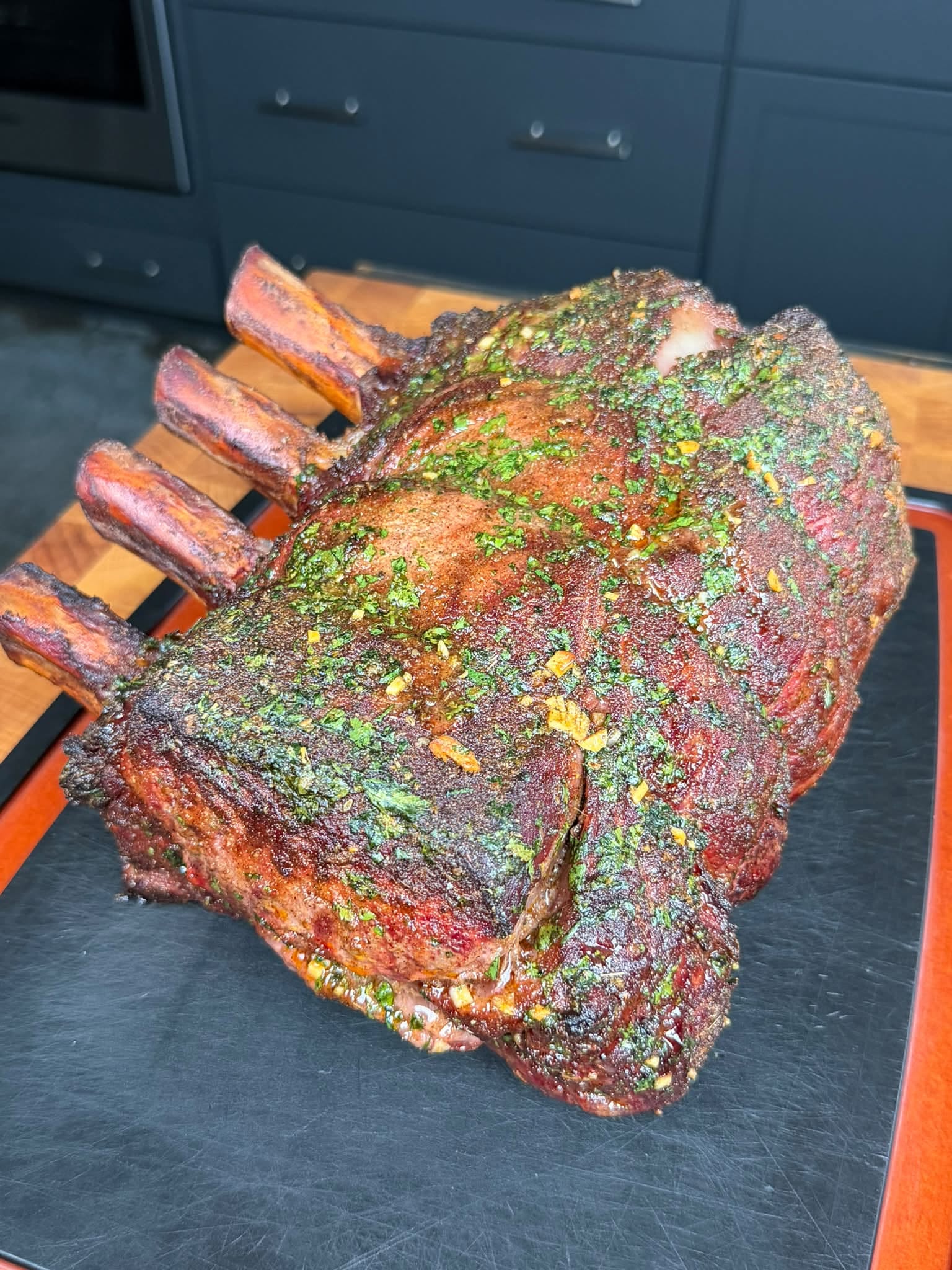
Smoked Cajun prime rib is a bone-in beef roast injected with garlic herb marinade and seasoned with Cajun spices. You inject the roast in a grid pattern so flavor penetrates every layer of muscle. Then you coat it with a dry rub made from Tony’s More Spice, salt, pepper, garlic powder, and smoked paprika. The roast smokes at 250°F for about 4 hours until it reaches 115-118°F internally. During smoking, you baste with Cajun honey butter every 45 minutes. This creates a mahogany crust. After smoking, you reverse sear at 500°F for 7 to 10 minutes to crisp the exterior. The result is tender beef with Louisiana-inspired flavor and buttery juiciness from the injection.
Table of Contents
Smoked Cajun Garlic Herb Prime Rib Recipe
Why Injection Makes Prime Rib More Consistently Juicy
How Tony’s More Spice Differs from Standard Prime Rib Seasoning
Smoked Cajun Prime Rib
📝 Ingredients
For the Prime Rib
Cajun Honey Butter Baste
Step-by-Step Instructions
Step 1: Inject the Prime Rib with Garlic Herb Marinade
Step 2: Apply the Cajun Dry Rub
Step 3: Preheat the Smoker and Set Up Drip Pan
Smoked Cajun Garlic Herb Prime Rib
Ingredients 1x2x3x
Instructions
Notes
View more
The whole process takes about 5 hours including prep, smoking, searing, and resting. The injection keeps every slice moist even at the ends of the roast. The Cajun seasoning adds savory heat that complements the rich beef. The honey butter baste caramelizes during cooking and creates shine. This Cajun butter prime rib serves 8 to 12 people and works perfectly for Christmas, Thanksgiving, or any holiday gathering where you want bold flavor and impressive presentation.
Why Injection Makes Prime Rib More Consistently Juicy
Injecting garlic herb prime rib distributes moisture and flavor throughout the entire roast. Prime rib has thick muscle sections that dry rub can’t penetrate. Even with perfect cooking technique, the outer portions get more seasoning than the center. Injection solves this by delivering liquid directly into the meat’s interior.
Tony’s Roasted Garlic Herb Injectable Marinade contains butter, garlic, herbs, and seasonings in liquid form. When you inject it into the beef, it travels along the muscle grain and fat seams. The butter coats the muscle fibers from the inside. As the roast smokes, this internal moisture prevents drying. The garlic and herbs season every bite, not just the crust.
The injection technique involves pushing a meat injector needle deep into the roast at multiple points. You create a grid pattern with injection sites every 1 to 2 inches. Each injection deposits marinade at different depths. This ensures complete coverage. When you slice the finished prime rib, even the center pieces have garlic herb flavor.
Compare this to dry rub alone. Rub sits on the surface and forms a crust. It doesn’t penetrate more than a quarter inch deep. The exterior tastes great but the interior can be bland. With injection, you get seasoning throughout. The difference is especially noticeable in larger roasts where the center is far from the surface.
Injection also helps with doneness consistency. The added liquid conducts heat more efficiently than dry meat. This promotes even cooking from edge to center. You get less of a gray overcooked band around a rare center.
How Tony’s More Spice Differs from Standard Prime Rib Seasoning
Tony’s More Spice brings Louisiana Cajun flavor to smoked Cajun prime rib that standard beef seasoning can’t match. Traditional prime rib rubs use salt, pepper, garlic, and maybe some dried herbs. Tony’s adds paprika, cayenne, and Creole spice blends that create heat and depth. The flavor profile is bolder and more complex.
The cayenne in Tony’s provides moderate heat that wakes up your palate. It’s not overwhelming but you notice it. This heat cuts through the rich fattiness of prime rib. Without some spice, prime rib can taste heavy. The cayenne lightens it and adds excitement.
Tony’s also contains onion, garlic, and other savory spices in specific ratios developed for Louisiana cooking. These proportions create balance that’s hard to replicate by mixing your own spices. The seasoning works particularly well with smoked meat since the smoke flavor complements Cajun spices naturally.
The paprika in Tony’s adds color and mild sweetness. When combined with honey butter baste, it caramelizes beautifully. You get a dark red-brown crust that looks dramatic on the serving platter. Standard salt and pepper prime rib stays pale by comparison.
If you can’t find Tony’s More Spice, you can substitute Cajun or Creole seasoning blends like Slap Ya Mama or Zatarain’s. Look for blends that list cayenne or red pepper in the first few ingredients. Avoid ones that are mostly salt. You want spice-forward seasoning for authentic Cajun flavor.
You can also make your own Cajun spice blend. Mix paprika, cayenne, garlic powder, onion powder, oregano, thyme, black pepper, and salt. The key is getting the cayenne ratio right for heat without making it painful.
What Temperature to Smoke Cajun Prime Rib For Best Results
Smoke Cajun garlic herb prime rib at 250°F for ideal balance between smoke absorption and tenderness. This temperature is slightly higher than the 225°F used for traditional herb butter prime rib. The extra 25 degrees helps render fat faster and builds crust without extending cooking time significantly.
At 250°F, prime rib develops good smoke ring and bark. The Cajun seasoning crusts up nicely without burning. The honey butter baste caramelizes during the cook without turning bitter. Lower temperatures like 225°F work but take 30 to 45 minutes longer. The extended time doesn’t improve tenderness for prime rib since it’s already a tender cut.
Higher temperatures like 275-300°F cook faster but create thicker gray bands of overcooked meat. You lose the edge-to-edge pink that makes prime rib impressive. The smoke flavor also doesn’t penetrate as deeply at higher temps since the meat spends less time in the smoker.
Plan for 25 to 30 minutes per pound at 250°F. A 10-pound roast takes about 4 to 4.5 hours. A 14-pound roast takes 5.5 to 6 hours. These are estimates. Always cook to internal temperature, not time. Pull the roast when it hits 115-118°F in the thickest part away from the bone.
Use hickory, oak, or pecan wood for smoked Cajun prime rib. Hickory provides strong, bacon-like smoke that stands up to the Cajun spices. Oak is more subtle and lets the Tony’s seasoning shine. Pecan adds nutty sweetness that complements the honey butter baste. All three work excellently with beef.
Avoid mesquite wood. It’s too strong and can overpower the other flavors. Fruit woods like apple and cherry are too mild for Cajun-seasoned beef. Save those for pork or poultry.
Does the Reverse Sear Work Differently on Cajun Prime Rib
The reverse sear technique works the same way on smoked Cajun prime rib as traditional prime rib. You smoke low and slow until the internal temperature reaches 115-118°F. Then you crank the heat to 500°F and sear for 7 to 10 minutes. This creates a crispy, caramelized crust while the interior stays perfectly cooked.
The Cajun seasoning and honey butter baste respond beautifully to high heat. The sugars in the honey caramelize quickly at 500°F. The paprika in Tony’s More Spice darkens and forms a mahogany bark. The cayenne becomes more pronounced but doesn’t taste burnt. The fat cap renders further and crisps up.
Watch the roast closely during the sear. The honey content means the crust can go from perfect to charred in 1 to 2 minutes. Check at the 7-minute mark. If it looks dark brown and crusty, it’s done. If it’s still pale, give it another 2 to 3 minutes.
The internal temperature will rise 5 to 10 degrees during the sear. If you pulled the roast at 115°F, it will climb to 120-125°F during searing and resting. This lands perfectly at medium-rare. If you pulled at 118°F, it finishes around 125-130°F.
You can reverse sear in your smoker if it can reach 500°F. Most pellet grills can hit this temperature. Stick burners and offset smokers can too if you stoke the fire. If your smoker won’t go that hot, transfer the roast to a 500°F oven for the sear. Or use a grill with direct high heat.
After searing, let the prime rib rest for 25 to 35 minutes. Tent it loosely with foil. This resting period is critical. The juices redistribute throughout the meat. If you slice immediately, liquid runs out onto the cutting board. Rested meat stays juicy and slices cleanly.
